The Systems Theory Framework of career development, Te Anga Ariā Pūnaha o te whakawhanake aramahi
Updated 24 Aug 2026
The Systems Theory Framework draws on systems thinking and recognises that career development is shaped by the interaction between personal, social, cultural and environmental influences over time.
Contents
- Career theories and models
- Holland’s theory of career choice
- Donald Super’s life-span, life-space theory
- Krumboltz’s theory of planned happenstance
- Chaos theory of careers
- McCashen’s strengths-based practice framework
- The Systems Theory Framework of career development
- Hope-Action Theory
- Narrative approach to career counselling
- Career Construction Theory
Theory overviewTirowhānui aria,
The Systems Theory Framework was developed by Wendy Patton and Mary McMahon. It recognises that career development is shaped by many interacting parts, including the individual, the people around them and the wider social, cultural and economic environment. These parts are best understood in relation to the whole system.
The framework is not a stand-alone career theory and does not focus on specific constructs such as interests, values or personality. Instead, it brings together ideas from different career theories and shows how personal, social and environmental influences interact over time. This gives practitioners flexibility to draw on the approaches that best support the person they are working with.
The framework also helps practitioners to see how different career theories connect. Some theories focus on what influences career development, while others focus on how career development changes over time.
The framework is made up of three interconnected systems:
- the individual system
- the social system
- the environmental-societal system.
These systems sit within the context of past, present and future time. Past experiences influence the present, and together the past and present shape future possibilities. The framework also supports story telling by encouraging people to share their career stories, while the practitioner takes a collaborative rather than expert-led role.
Key conceptsNgā ariā matua,
The Systems Theory Framework recognises that careers are shaped by both who we are and the world around us. Personal factors, such as interests, values, skills and experiences, interact with external factors, such as family, culture, education, work opportunities and wider social conditions. The framework is usually shown as a circle, with the individual placed at the centre.
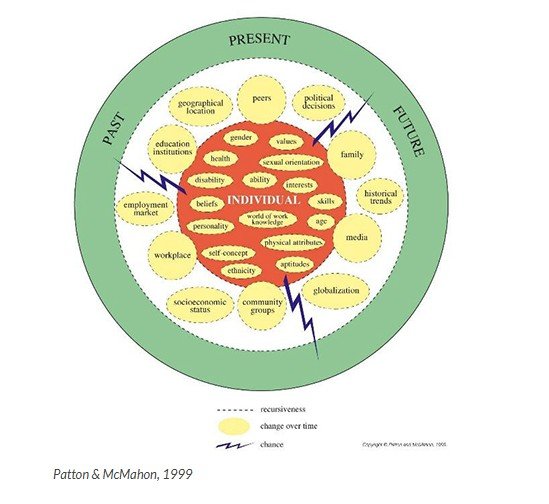
Systems Theory Framework, Patton & McMahon, 1999
The framework considers the following concepts:
Individual system (who am I) – personal characteristics such as interests, abilities, skills, personality, values, gender, health, beliefs and self-concept.
Social system (people around me) – influences from family, whānau, friends, peers, teachers, mentors, employers and community networks.
Environmental-societal system (the wider world around me) – wider influences such as culture, where we live, education and training opportunities, the labour market, technology and economic conditions.
Time (past, present and future) – career development is shaped by past experiences, current circumstances and future possibilities. What has happened before can influence how a person sees themselves and their options now, while present decisions and opportunities can shape future pathways.
Recursiveness (connected influences) – personal factors, relationships and wider environmental influences are connected. A change in one area can affect other areas and influence career development over time. For example, moving to a new city for study may create new friendships, learning opportunities and career possibilities.
Chance and change – unexpected events, opportunities and life changes can influence career decisions. Careers often develop over time rather than following a single fixed path.
Context and culture – career development is shaped by the cultural, social and environmental contexts in which people live, learn and work.
Practical uses in career practiceNgā whakamahinga whaitake i ngā mahi aramahi,
The Systems Theory Framework offers a holistic approach to career development and can be used with people at any life stage. It helps career practitioners explore the influences that may support or limit a person’s career decisions.
Using the Systems Theory Framework in practice can help practitioners to:
- identify the personal, social and environmental influences on a person’s career development
- explore how past experiences have shaped current thinking about work, learning and life roles
- use narrative conversations to help people tell their career stories and identify themes, strengths and aspirations.
When working with students, practitioners can use the framework to:
- help students understand how family, whānau, school, community and wider opportunities can influence their career choices
- guide students to consider the wider context of their decisions, including the people, places and systems that shape their options
- support students to identify useful resources, such as teachers, mentors, whānau and community networks, and use these to take practical next steps.
Implications for career developmentNgā rara ki te whanaketanga aramahi,
The Systems Theory Framework highlights that career development needs to be understood within the context of a person’s whole life. This means considering the personal, social and environmental influences that shape their options, decisions and next steps.
When applying the framework, practitioners need to consider how relationships, culture, community, life circumstances and wider societal factors may influence a person’s career journey.
SourcesNgā pūtake,
Patton, W., & McMahon, M. (2021). Career Development and Systems Theory: Connecting Theory and Practice (4th ed.). Routledge.
McMahon, M. (2024). Putting the Systems Theory Framework of Career Development into Practice. CareerWise.
Putting the Systems Theory Framework of career development into practice – CareerWise